

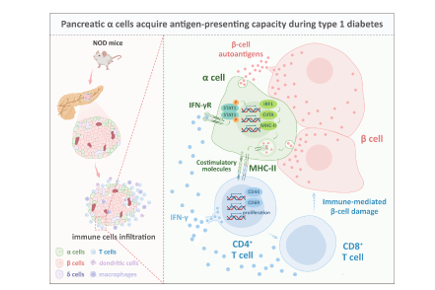
Graphical abstract illustrating pancreatic α cells acquiring MHC-II-dependent antigen-presenting capacity and activating CD4+ T cells during type 1 diabetes progression. [Photo/en.xmu.edu.cn]
A joint team led by Professor Li Mingyu from the School of Pharmaceutical Sciences at Xiamen University (XMU), Professor F. Susan Wong from Cardiff University in Wales, and Professor Jie Zuliang from the School of Life Sciences at XMU has found that during type 1 diabetes (T1D) progression, pancreatic α cells acquire MHC class II (MHC-II)-dependent, an antigen-presenting ability in an inflammatory environment. The findings were published online in Science Advances under the title "Pancreatic α cells function as MHC class II-dependent antigen-presenting cells in type 1 diabetes".
T1D is an autoimmune disease in which immune cells attack insulin-producing β cells. Professional antigen-presenting cells, such as dendritic cells, macrophages, and B cells, initiate and amplify autoreactive T-cell responses through antigen presentation. Whether pancreatic endocrine cells, including α cells, can also present antigens has remained unclear.
The team found that as T1D progresses, antigen processing and presentation pathways in α cells are enhanced, with upregulated MHC-II-associated genes. Inflammatory cytokines increase MHC-II expression by activating the JAK-STAT1-IRF1 signaling axis. Inflammation-activated MHC-II+ α cells can internalize and process exogenous antigens, promote T-cell proliferation, and increase the expression of the T-cell activation markers CD44 and CD69. Inflammation also induces costimulatory molecules such as CD80, CD86, and CD40.
These results show that α cells can take up, process, and present exogenous antigens and activate antigen-specific CD4+ T cells, acting as nonprofessional antigen-presenting cells in local islet immune responses. The study expands the traditional view of pancreatic endocrine cells as mere targets of immune attack and offers a new perspective on T1D.