

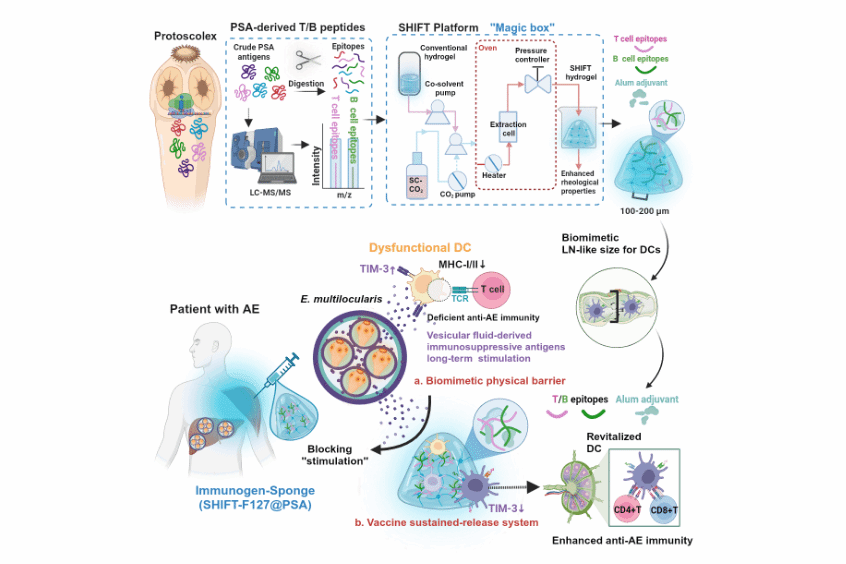
Graphical abstract illustrating the construction, immunomodulatory mechanism, and anti-AE effects of the immunogen-sponge hydrogel vaccine. [Photo/en.xmu.edu.cn]
Professor Liu Gang's team at the School of Public Health, Xiamen University, together with Associate Professor Cheng Zhe's team at the School of Life Sciences, focused on the dysfunction of dendritic cells (DCs) in Alveolar echinococcosis (AE).
They found that an elevated expression of the immune checkpoint molecule TIM-3 is closely linked to impaired DC antigen presentation. The findings were recently published in Cell Reports Medicine, in a paper titled "Immunogen-sponge hydrogel reverses TIM-3-mediated dendritic cell dysfunction in alveolar echinococcosis".
Alveolar echinococcosis (AE), a severe parasitic disease caused by Echinococcus multilocularis, is prevalent in parts of western China. The disease is known as "parasitic cancer" because of its tumor-like invasive growth. The current treatment relies mainly on surgery and drugs such as albendazole, but complete removal of lesions remains difficult. Long-term medication and disease recurrence pose challenges. No approved vaccine exists for humans.
The team used the superstable homogeneous intermixed formulation technology (SHIFT) to build an immunogen-sponge hydrogel vaccine with a biomimetic porous structure. The platform uses a physical barrier to reduce DC contact with immunosuppressive antigens from parasite cyst fluid.
Meanwhile, it continuously releases T- and B-cell epitope peptides derived from protoscoleces. This lowers the TIM-3 expression on DCs, promotes their maturation and antigen presentation, and synergistically modulates the local immune microenvironment.
In experiments conducted on mice, prophylactic vaccination significantly inhibited lesion growth and reduced the parasite burden and hepatic dissemination. Therapeutic vaccination also showed antiparasitic effects, and its combination with albendazole further improved parasite clearance. The current evidence is based on cell and animal studies, and clinical application requires further validation.