

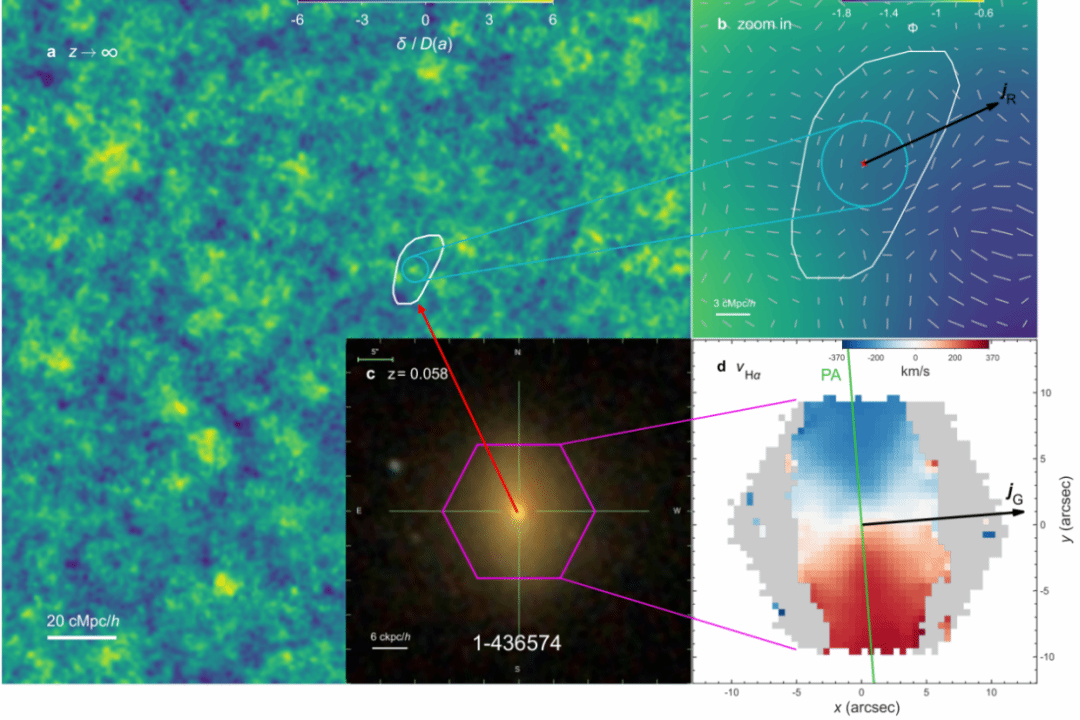
Correlation between observed and reconstructed primordial galaxy angular momentum. [Photo/en.xmu.edu.cn]
A team led by Professor Yu Haoran from Xiamen University's College of Physical Science and Technology has detected a high-significance imprint of primordial tidal torque in observed galaxies, providing direct evidence for a classic theory explaining how galaxies gain angular momentum.
The Science website described the findings as the best evidence yet of a surviving imprint of primordial galaxy spin.
Published in Nature Astronomy under the title "A high-significance detection of primordial tidal torque imprints", the study confirms a key prediction that the scale at which angular momentum is acquired changes with the mass of a galaxy's dark matter halo.
Tidal-torque theory holds that misalignment between primordial matter distributions and surrounding gravitational tidal fields generated torque in the early universe, imparting angular momentum to proto-galaxies and dark matter halos.
The team combined MaNGA data with the ELUCID reconstruction of initial conditions in the nearby universe. Using two-dimensional velocity fields, the researchers measured present-day angular momentum directions and reconstructed their primordial tidal environments to predict early angular momentum directions.
The observed galaxy angular momenta showed a significant correlation with the predictions. The strongest signal was observed in the gas components of central elliptical galaxies, with a statistical significance of about 7 sigma.
The study also found that the primordial tidal environment scale associated with angular momentum increased with dark matter halo mass, consistent with a key prediction of tidal-torque theory.
The results indicate that galaxy angular momentum could become a new cosmological observable for studying the universe's initial conditions and constraining parameters such as neutrino mass.