
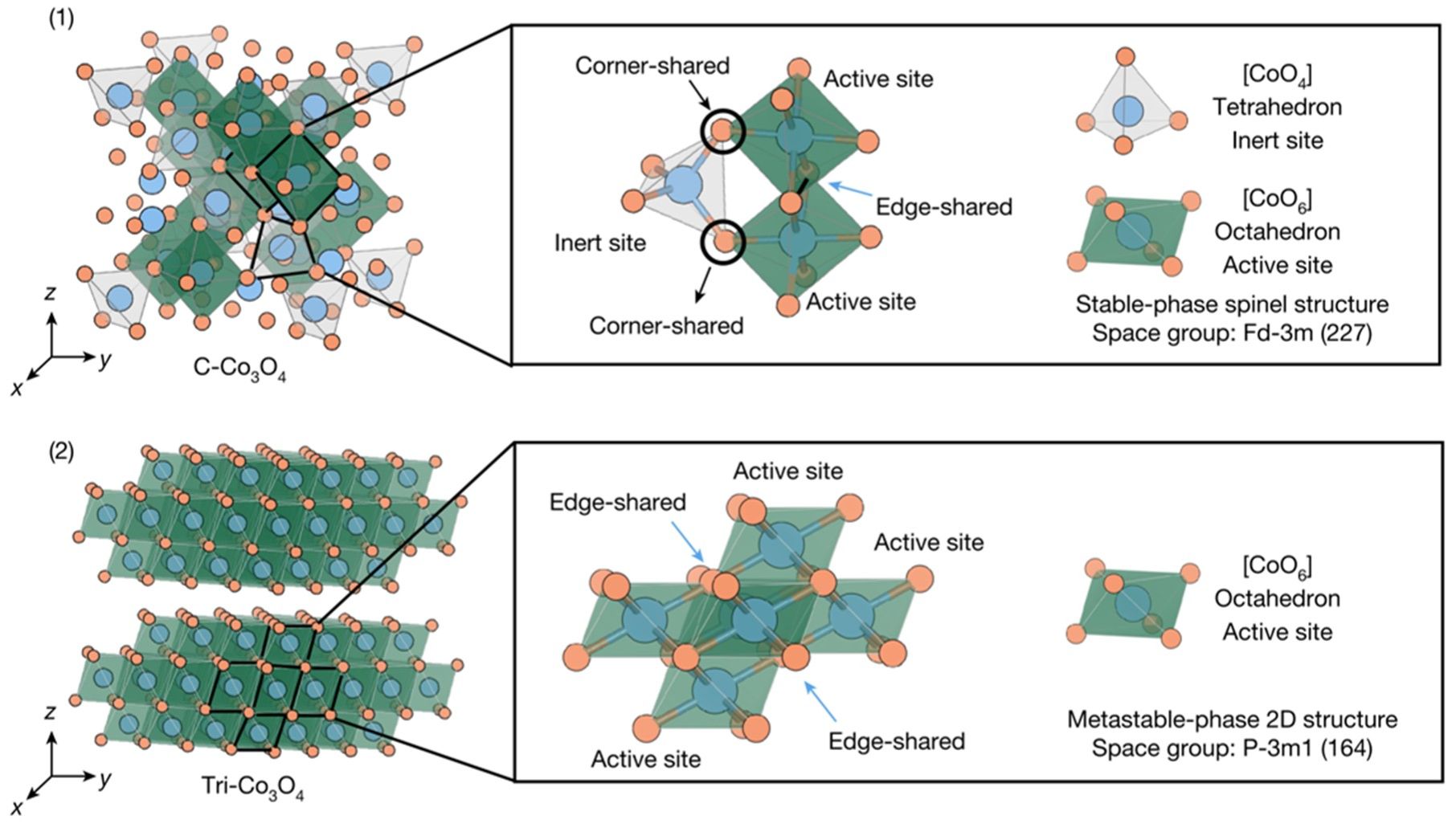
Schematic structures of (1) cubic-phase Co₃O₄ and (2) trigonal-phase Co₃O₄. [Photo/en.xmu.edu.cn]
Researchers from Xiamen University (XMU) and Soochow University (SCU) have developed a new cobalt oxide catalyst that improves the efficiency and stability of acidic water electrolysis, a potential alternative to iridium-based materials in hydrogen production.
The study, led by Professor Huang Xiaoqing of XMU's College of Chemistry and Chemical Engineering and Professor Shao Qi of SCU, was published in the journal Nature on July 29 under the title "Octahedral-coordinated Co₃O₄ for water electrolysis in acid".
Traditional spinel cobalt oxide (Co₃O₄) is a widely studied non-noble metal catalyst for the acidic oxygen evolution reaction (OER), but its performance is limited by the coexistence of less active tetrahedral (Td) and highly active octahedral (Oh) coordination sites.
The team developed a new trigonal-phase Co₃O₄ (Tri-Co₃O₄) using a vacuum-mediated molten-alkali mechanochemical method. The material features a three-layer compact structure with edge-shared [CoO₆] octahedral coordination, in which Co²⁺ and Co³⁺ occupy octahedral sites at a ratio of 1:2.
Tests showed that Tri-Co₃O₄ achieved an overpotential of 269 millivolts (mV) at a current density of 10 mA cm⁻² in the acidic oxygen evolution reaction (OER), 181 mV lower than that of spinel-type Co₃O₄. It also reached a current density of more than 1,800 mA cm⁻² at a cell voltage of 1.80 V in proton-exchange membrane water electrolysis (PEMWE) devices.
The researchers found that the two-dimensional layered structure optimized the adsorption of reaction intermediates and reduced cobalt dissolution, thereby improving catalyst activity and durability.