
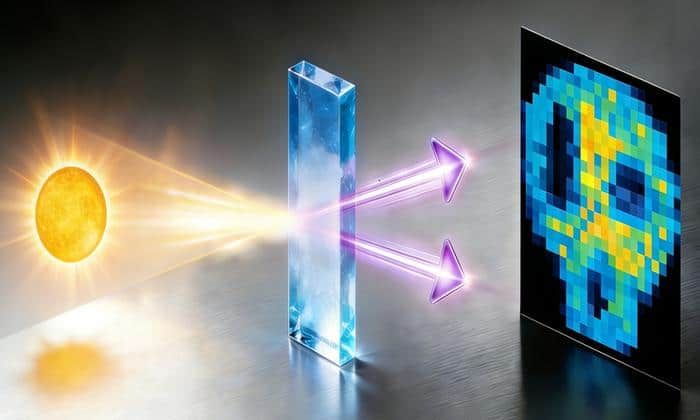
Sunlight-generated correlated photon pairs enable ghost imaging through spontaneous parametric down-conversion. [Photo/en.xmu.edu.cn]
Researchers from Xiamen University have developed a sunlight-driven method to generate correlated photon pairs, a breakthrough that could help reduce reliance on laser-based systems in quantum imaging and space applications.
The team, led by Associate Professor Zhang Wuhong and Professor Chen Lixiang, used sunlight as the pump source to excite a nonlinear optical crystal and produce photon pairs through spontaneous parametric down-conversion (SPDC), with the findings published in Advanced Photonics.
The researchers demonstrated that photon pairs generated from sunlight showed strong spatial correlations and could be used for ghost imaging, a technique that reconstructs images through correlations between photons. The imaging performance was comparable to that achieved using a laser source with similar pump power.
The work was recently highlighted by Physics World, an IOP Publishing platform that covers research and innovation in physics, which interviewed Zhang and Chen about the experiment's challenges and potential applications. Traditionally, SPDC experiments have relied on coherent laser sources, but the study showed that naturally incoherent sunlight could also drive the process.
To collect sufficient sunlight, the team installed a sun-tracking system on the roof of their laboratory and coupled the collected light into a multimode fiber before directing it into a periodically poled potassium titanyl phosphate crystal.
The researchers said the approach could enable laser-free and electricity-independent quantum light sources for applications such as remote sensing, space-based quantum key distribution and quantum imaging. They are also exploring ways to improve sunlight collection efficiency and integrate artificial intelligence techniques into quantum imaging systems.