

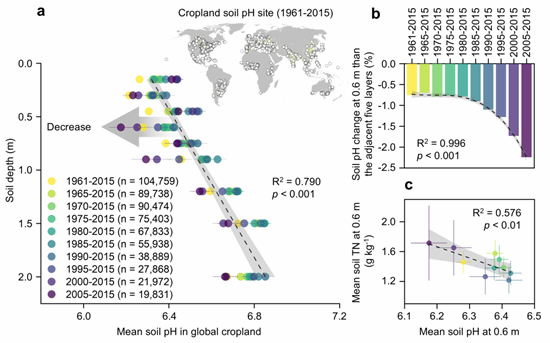
Vertical distribution and temporal changes of soil pH in global croplands. [Photo/en.xmu.edu.cn]
A joint study by Xiamen University's College of the Environment and Ecology, Fujian Provincial Key Laboratory for Coastal Ecology and Environmental Studies, and the University of Hong Kong has identified a previously overlooked soil layer that accelerates nitrogen transformation and groundwater nitrate pollution in croplands.
Their findings were published in Nature Communications under the title "Preventing subsoil enhanced nitrification to safeguard agroecosystem sustainability".
The study addresses global nitrogen imbalances by integrating long-term monitoring data from the Jiulong River Watershed with global cropland soil profiles. Researchers discovered a consistent "enhanced nitrification layer (ENL)" at roughly 0.6 meters below the surface, where total nitrogen peaks and nitrification is significantly intensified. This layer acts as a hidden driver of soil acidification and nitrate leaching, processes that threaten crop yields and water quality.
Analysis revealed that ammonium peaks occur between 0.3 and 0.75 meters, while nitrate peaks occur at 0.45 to 0.9 meters, indicating a "substrate above, product below" pattern not explained by leaching alone. The ENL's formation depends on four factors: root channels transporting surface nitrogen downward, oxygenated subsoil microenvironments, dense communities of ammonia-oxidizing microbes, and hydrological activation through rainfall or irrigation. Field observations at a Jiulong River tributary in Pinghe county, Fujian province, confirmed these mechanisms.
The discovery provides a scientific basis for extending nitrogen management below the surface. Targeted interventions, such as nitrification inhibitors at ENL depth combined with controlled irrigation and fertilization, could reduce nitrate leaching, mitigate subsoil acidification, and enhance both crop productivity and environmental safety.