

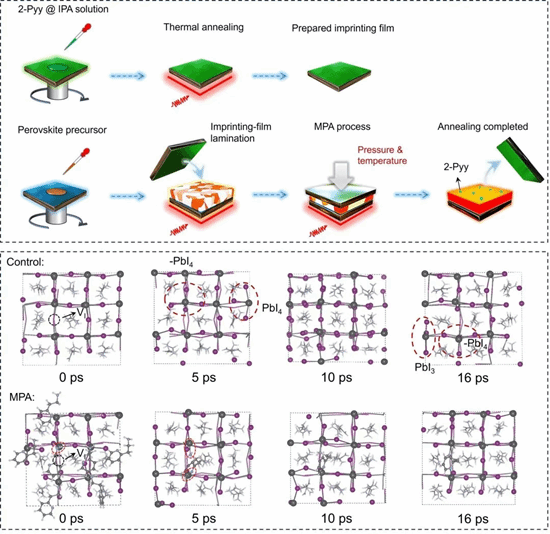
An illustration of the molecular press annealing process and the underlying molecular interaction mechanism. [Photo/en.xmu.edu.cn]
A study titled "Molecular press annealing enables robust perovskite solar cells", led by Professor Zhang Jinbao of Xiamen University's College of Materials and Professor Liang Chao of Xi'an Jiaotong University, has been published in Science on Jan 9. The research introduces a molecular press annealing (MPA) method that significantly enhances the stability of perovskite solar cells.
Perovskite solar cells are known for their high power conversion efficiency, low-cost fabrication, and simple production processes, making them a focus of research and industry.
However, conventional thermal annealing during perovskite film fabrication can induce crystal defects, such as iodine vacancies, which accelerate structural degradation and reduce device performance under operational conditions, including light exposure, heat, and humidity.
The MPA approach deposits a 2-pyridylethylamine molecular layer on the perovskite surface during thermal annealing, thereby forming a solid-state bidentate coordination complex with undercoordinated lead ions. This process stabilizes the lead-iodine framework in real time, simultaneously promoting crystallization and suppressing defect formation.
Using this method, small-area cells (0.08 square centimeters) achieved a certified power conversion efficiency of 26.5 percent, larger devices of 1 square centimeters reached nearly 25 percent efficiency, and 16 square centimeters modules maintained 23 percent.
The solar cells also demonstrated long-term durability: after 1,617 hours of continuous operation at 85 C and 60 percent relative humidity, devices retained 98.6 percent of their initial efficiency, and storage under ambient conditions for 5,280 hours caused minimal performance loss, meeting international ISOS-L-3 and ISOS-D-1 standards.