
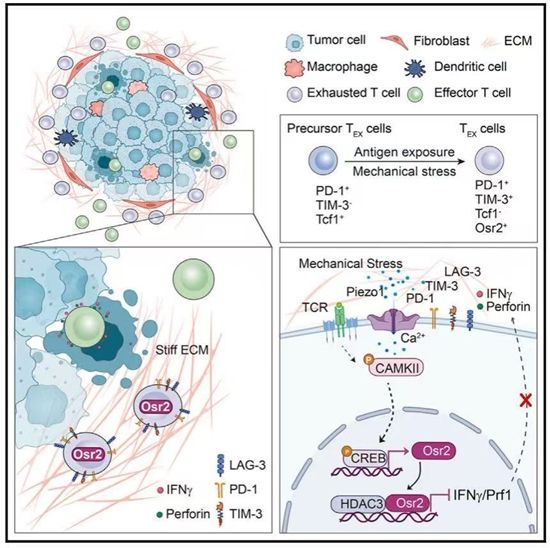
Schematic diagram of the mechanism. [Photo/en.xmu.edu.cn]
In the progression of common solid tumors such as liver, breast, and pancreatic cancers, tumor tissue often becomes increasingly fibrotic and markedly stiffer. Clinical data have long shown that stiffer tumors correlate with higher risks of recurrence and poorer treatment outcomes, yet the underlying biological mechanism remained unclear.
A joint study by the School of Life Sciences at Xiamen University (XMU) and the Army Medical University, recently published in Cell, has finally cracked the code.
The researchers found that mechanical pressure generated by tumor stiffening activates the Piezo1 receptor on the surface of T cells, a type of immune cell. This activation induces the transcription factor Osr2, which then recruits the protein HDAC3, suppressing the synthesis of cytotoxic molecules in T cells. Osr2 does not affect early T cell development. Instead, it is selectively activated under sustained tumor antigen stimulation within a high-stiffness tumor microenvironment, driving terminal T cell exhaustion.
Building on this mechanism, the XMU team modified existing CAR-T therapy by deleting the Osr2 gene in T cells. In experimental models, this approach alleviated T cell exhaustion, improved cell survival, and significantly inhibited solid tumor growth.
Professor Chen Lanfang noted that current CAR-T therapies remain costly and limited in scope. The team aims to further refine the technology and promote its clinical translation through national university-based technology transfer platforms, with the goal of reducing costs and expanding treatment options for patients with hard-to-treat solid tumors.