
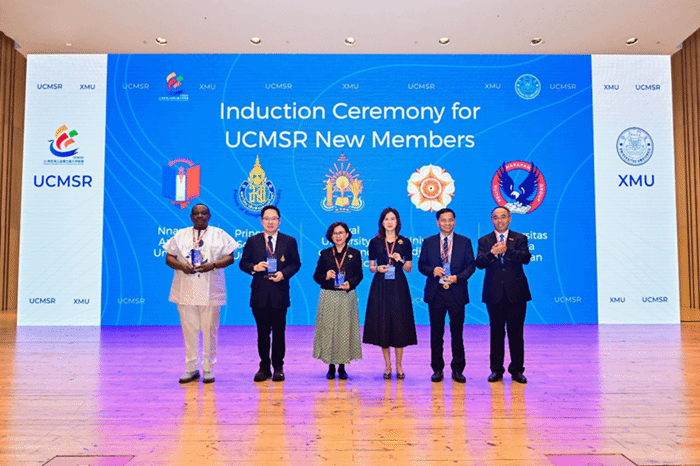
The Induction Ceremony for UCMSR New Members. [Photo/en.xmu.edu.cn]
The Second University Presidents Forum of the University Consortium of the 21st Century Maritime Silk Road (UCMSR) was successfully held at Xiamen University on June 12 under the theme "Connecting the World via the Maritime Silk Road, Forging the Future with Digital Intelligence". The event brought together university leaders and representatives from around the world to discuss innovative practices in higher education, explore shared challenges, and identify new pathways for collaboration in education, research, and innovation.
The opening ceremony was attended by Zhao Lei, Deputy Director-General of the Department of International Cooperation and Exchanges of China's Ministry of Education; Wu Weiping, Level I Bureau Rank Official of Fujian Provincial Department of Education; and Hu Wenping, President of Xiamen University and newly elected Chair of the UCMSR Council. The ceremony was moderated by Shi Dalin, Vice President of Xiamen University.
In his remarks, Zhao Lei highlighted the increasingly important role of higher education in fostering international cooperation amid profound global transformations. He commended the achievements of the consortium since its establishment and encouraged member institutions to deepen collaboration in talent cultivation, scientific innovation, and educational governance.
Wu Weiping noted that Fujian province, as a core area of the 21st Century Maritime Silk Road, has actively promoted educational openness and international exchanges. He expressed confidence that the consortium would continue to serve as an important platform for advancing educational cooperation and people-to-people connectivity among participating countries and regions.
On behalf of Xiamen University and the consortium, Hu Wenping welcomed all participants and reviewed the development of UCMSR since its founding in 2018. He noted that the consortium has expanded to 73 member universities and research institutions across five continents and has established a wide range of collaborative initiatives. Looking ahead, he called on member institutions to embrace digital transformation, strengthen innovation-driven development, cultivate globally competent talents, and work together to build a vibrant community for education, science, technology, and innovation.
During the opening ceremony, five universities officially joined the consortium: Nnamdi Azikiwe University (Nigeria), Prince of Songkla University (Thailand), Royal University of Law and Economics (Cambodia), Universitas Gadjah Mada (Indonesia), and Universitas Pelita Harapan (Indonesia). Membership certificates were presented to representatives of the new member institutions.
The forum featured a keynote session with distinguished speakers from academia and international organizations. Fabrizio Hochschild, former United Nations Under-Secretary-General, delivered a keynote address on global digital governance and sustainable development. Other speakers shared insights on topics including engineering education reform, artificial intelligence in higher education, university governance in the digital age, international educational cooperation, and the future of global higher education partnerships.
A roundtable dialogue brought together university leaders from China and abroad to discuss consortium development, regional cooperation, and new approaches to advancing higher education through international collaboration.
At the closing session, Hu Wenping introduced Xiamen University's achievements in internationalization and officially launched the Xiamen University Global Strategy 2030, outlining the university's vision for expanding global engagement and contributing to the development of a higher education community along the Maritime Silk Road.
In the afternoon, participants attended two parallel forums focusing on new models of international higher education cooperation and university technology transfer. Discussions covered digital transformation, industry–academia collaboration, innovation ecosystems, and the commercialization of research outcomes. An International Higher Education Exhibition and a showcase of innovative practices in global governance talent cultivation were also held, featuring nearly 20 universities from China and overseas.
The successful convening of the forum further strengthened the role of UCMSR as a platform for international academic cooperation and reaffirmed the commitment of member institutions to promoting innovation, connectivity, and sustainable development through higher education collaboration.