

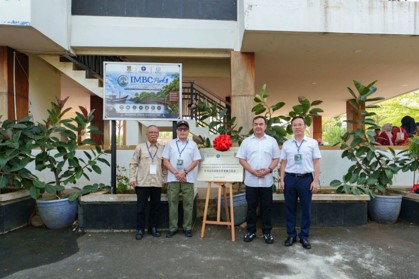
Guests unveil the China–Indonesia sister station for mangrove field observation. [Photo/en.xmu.edu.cn]
A research team from Xiamen University (XMU) recently visited Ketapang in Indonesia's Banten province to explore ways to balance mangrove conservation with the livelihoods of coastal communities.
At dawn, as the tide receded, XMU students Cao Zeyu and Xu Hongda, together with Indonesian peers Nuryani Widagti and Mita Aprilia, waded waist-deep through the marsh into the mangrove forest.
They installed surface elevation tables (SETs), portable mechanical leveling devices for measuring the relative elevation change of wetland sediments, brought from China to monitor changes in tidal-flat elevation.
Combined with measurements of tree growth and sediment composition, these readings help researchers assess the mangroves' carbon sequestration.
Many coastal communities in Indonesia rely on fish and shrimp farming in ponds carved out of mangrove forests. Chen Luzhen, a professor at XMU's College of the Environment and Ecology and the team's adviser, said blue carbon offers a way to reconcile conservation with local livelihoods.
By putting an economic value on the carbon stored in mangroves, researchers can help develop carbon market mechanisms that provide financial incentives for local communities to restore mangrove forests.
Researchers estimate that each hectare of restored mangroves in Ketapang can sequester 15 metric tons of carbon annually and generate about $5,000 in economic benefits each year.
The visit builds on more than a decade of blue carbon research conducted by XMU in Zhangzhou city, Fujian province.
In July, XMU's National Observation and Research Station for the Taiwan Strait Marine Ecosystem and Indonesia's IPB University launched a sister station for joint mangrove research.