
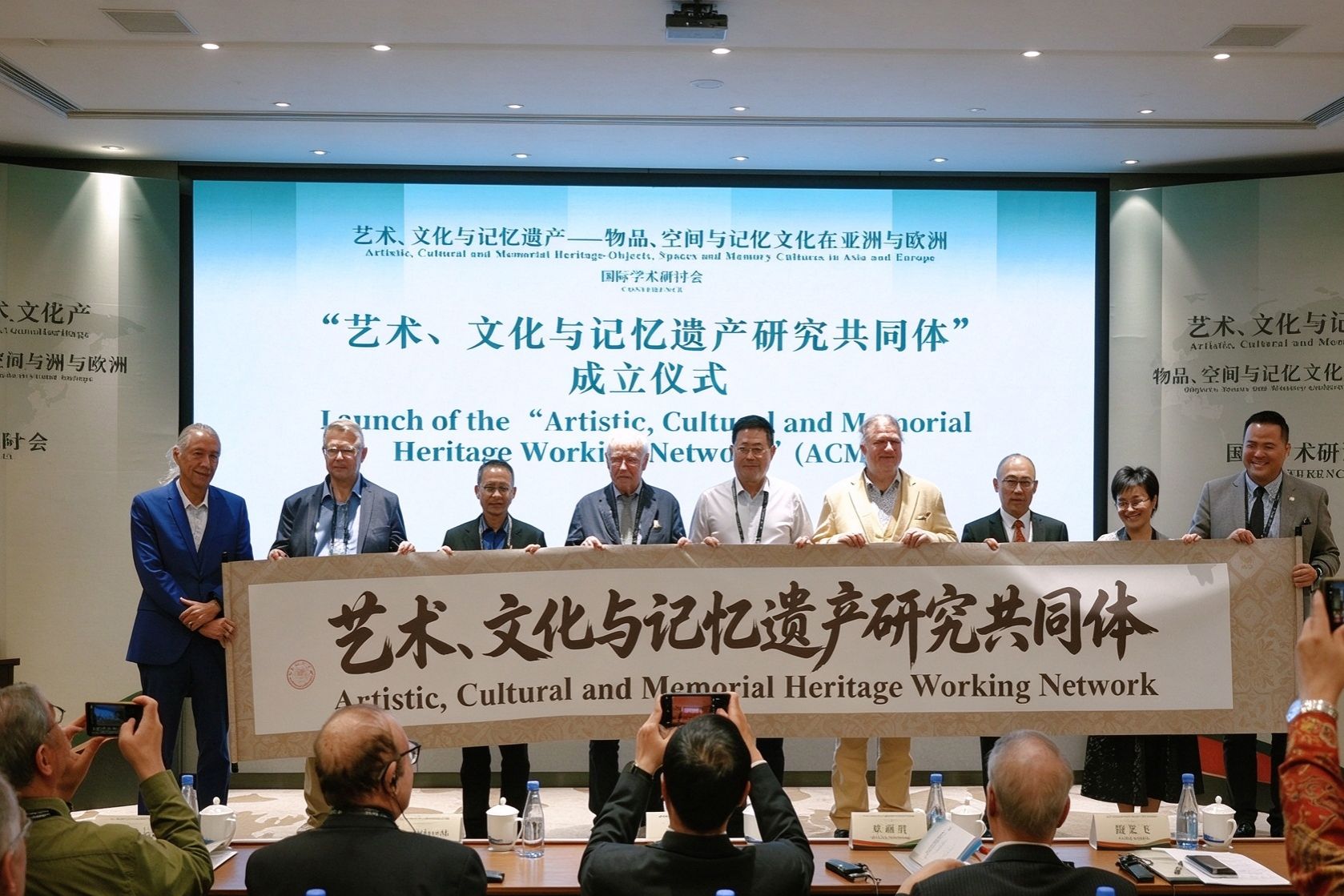
The launch ceremony of the Artistic, Cultural, and Memorial Heritage Working Network (ACMH). [Photo/en.xmu.edu.cn]
Xiamen University (XMU) hosted an international conference from Sept 19 to 20, examining how cultural heritage, objects, spaces, and collective memory have been shaped and preserved across Asia and Europe.
Titled "Artistic, Cultural, and Memorial Heritage: Objects, Spaces, and Memory Cultures in Asia and Europe", the conference brought together dozens of scholars and experts from China, Germany, Indonesia, Italy, the United Kingdom, and Japan. Discussions focused on art theft and cultural appropriation, cultural heritage and collective memory, and heritage preservation across global and local contexts.
The conference was the second part of "Interwoven Cultural Heritage: A Bridge for Cross-Cultural Connections", an international academic symposium held in Berlin, Germany, in July.
Wu Chaopeng, XMU's vice-president, said dialogue among civilizations can foster mutual understanding and common development. Echoing that emphasis on exchange, Pino Arlacchi, former United Nations under-secretary-general, called for China and Europe to rediscover their shared cultural heritage and learn from each other. Zhang Xinsheng, former president of the Executive Board of UNESCO and former chairman of UNESCO's World Heritage Committee, extended the discussion to heritage protection, calling for greater fairness and balance in global heritage-listing rules and describing historical memory as central to cultural heritage.
The conference also proposed the Artistic, Cultural, and Memorial Heritage Working Network (ACMH), initiated by XMU Professor Liu Yue and scholars and institutions from China and abroad.