

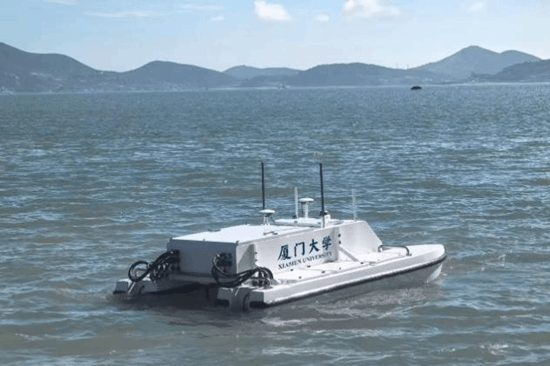
Haiwu-1 completes its first offshore voyage. [Photo/en.xmu.edu.cn]
Xiamen University's (XMU) College of Ocean and Earth Sciences has completed the first sea trials of its self-designed smart unmanned catamaran, Haiwu-1, capable of supporting multiple scientific and engineering missions.
The vessel can carry diverse equipment for ocean surveys, autonomous navigation, intelligent obstacle avoidance, and underwater operations, providing long-endurance, near-real-time, multi-source data integration for both research and industrial applications.
Traditional ocean monitoring relies heavily on crewed ships, which are costly, difficult to schedule, and often lack real-time data, especially in shallow or complex coastal waters. To address these challenges, the OCCUS team designed Haiwu-1, an intelligent unmanned catamaran to enhance the flexibility, cost-effectiveness, and intelligence of marine observation.
The three-meter-long, 1.5-meter-wide, and 0.8-meter-high vessel features a modular twin-hull structure made from flame-retardant, environmentally friendly polymers and can carry up to 80 kilograms of payload. It reaches speeds of 6 meters per second, operates continuously for over 12 hours, and supports remote control and high-speed data transmission within a 3-kilometer range via short-range radio and the Beidou navigation system. An onboard automated winch facilitates deployment of lightweight instruments.
Haiwu-1 can carry a wide range of acoustic and optical sensors, including radar, AIS receivers, and optical sensors, with the capacity to integrate additional systems in future upgrades.
According to Professor Li Jianghui, head of the OCCUS team, Haiwu-1 enhances precision and efficiency for ocean engineering, geological surveys, underwater archaeology, coral reef monitoring, and other applications. For example, continuous monitoring in areas of potential seabed gas migration can inform environmental assessments and engineering safety.