

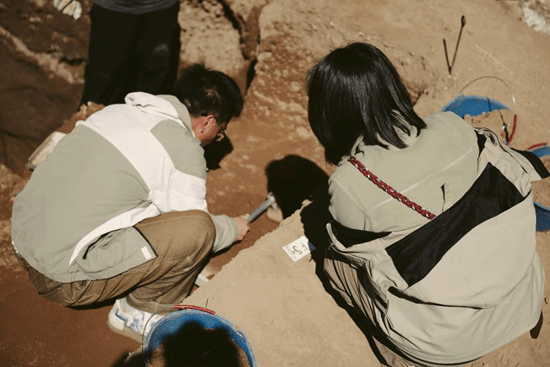
Excavation in progress at the prehistoric site in Thanh Hoa province. [Photo/en.xmu.edu.cn]
China and Vietnam have launched a joint archaeological excavation at the Dong Vanh rock shelter in Vietnam's Thanh Hoa province to investigate prehistoric cultural links between East and Southeast Asia.
The project, initiated in late 2025, is jointly led by the School of History and Cultural Heritage at Xiamen University (XMU), the Guangxi Institute of Cultural Relics Protection and Archaeology, and the Institute of Archaeology under the Vietnam Academy of Social Sciences.
A Chinese research team led by Zhang Wenjie, vice-dean of XMU's School of History and Cultural Heritage, traveled to Vietnam in December 2025 to conduct fieldwork at the site. The excavation marked the second joint China-Vietnam archaeological investigation at the Dong Vanh rock shelter.
Researchers uncovered burial remains, including flexed burials, along with artifacts such as stone tools, animal bones, shells and ochre. Several stone implements, including Sumatra-type tools and short axes, were identified as characteristic of the Hoa Binh culture, providing material evidence for understanding prehistoric cultural patterns in the region.
The excavation concluded on Jan 9. An expert panel comprising specialists from the Vietnam Academy of Social Sciences' Institute of Archaeology, the Vietnam National Museum of History, and the Thanh Hoa Center for Historical Research and Heritage Conservation conducted a formal review of the site.
The Dong Vanh project is the second archaeological excavation undertaken by XMU in Vietnam and contributes to ongoing bilateral cooperation in cultural heritage research.